
 Too long, I want to choose to read it.
Upgrading alloy wheels on modern Electric Vehicles (EVs)—such as switching to lightweight Flow Forming or Forged wheels to reduce unsprung weight, improve driving range, and enhance acceleration—has become a massive trend among car enthusiasts.
However, a crucial engineering question often worries EV owners: "When changing alloy wheels, should we check the Max Load capacity on the wheel or on the tire?" Today, we will break this down to ensure safe and proper modifications for your electric vehicle.
Hypothetical scenario based on typical mid-size EV wheel upgrades:
Wheel Specs: Maintaining factory-matching width and offset for a flush fender fitment.
Modification Goal: Reduce unsprung weight significantly while retaining original OEM tire sizes.
The Dilemma:
Aftermarket alloy wheels are stamped on the back with a Max Load rating per wheel (e.g., 690 kg per wheel, totaling 2,760 kg across 4 wheels), while the curb weight of a mid-size EV sits around 2,185 kg, leaving a specific margin for passengers and cargo.
Meanwhile, OEM tires specify a high individual Load Index rating (e.g., 775 kg per tire), appearing higher than the wheel's structural rating.
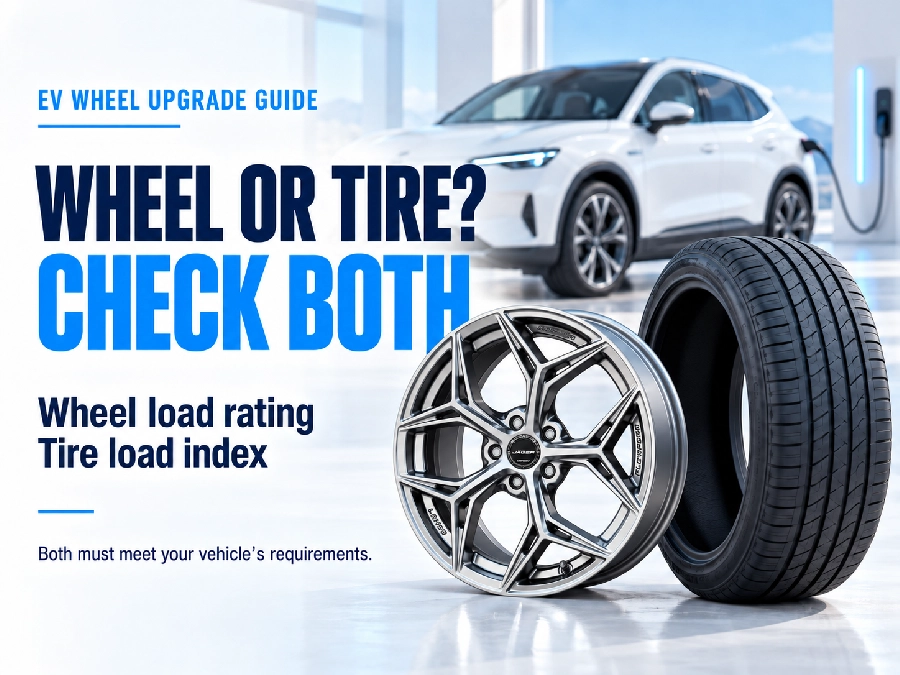
In automotive engineering and safety, "Both must meet structural requirements and remain safe!" However, their functional roles in weight support differ:
Alloy Wheels Handle Total Structural Load: The Max Load rating of 690 kg per wheel (2,760 kg total) represents the absolute structural limit the wheel can support. If the Gross Vehicle Weight Rating (GVWR) exceeds this threshold, structural failure can occur.
Tires Handle Dynamic Load via Air Pressure: The tire's Load Index (e.g., 99 = 775 kg/tire) defines the tire's individual carrying capacity under specified inflation pressure, typically built with a high safety factor.
Curb Weight (AWD Performance) = 2,185 kg
Total 4-Wheel Structural Capacity (690 x 4) = 2,760 kg
Load Margin: Leaves a remaining buffer of 575 kg for passengers, cargo, and dynamic forces during braking/cornering. This is adequate for normal daily driving since the actual payload of a mid-size sedan will not exceed this limit.
Even though the numbers check out for safe everyday driving in this scenario, modifying wheels on an EV requires stricter considerations than traditional combustion engine cars:
High Density & Weight of EVs (Heavy Battery Packs): EVs carry heavy battery packs under the floor, resulting in higher total weight than ICE cars of similar size. Always inspect the Max Load rating stamped on the back of the wheel spokes or barrel when purchasing aftermarket wheels. Never rely solely on size and width.
Driving Habits and Road Conditions: EVs deliver instantaneous massive torque and heavy regenerative braking forces. Driving over large potholes at high speeds with a narrow load margin increases the risk of wheel bending or cracking.
Consult Wheel Experts: At Jager Wheel, we prioritize safety and performance. If you are looking for model-specific alloy wheels that safely support your EV's weight while reducing weight, our team is ready to assist you.
Q: Why do electric vehicles (EVs) wear out tires faster and demand high-strength alloy wheels? A: EVs carry significantly more weight than ICE vehicles due to the battery pack and exhibit instantaneous torque delivery whenever the accelerator is pressed. The resulting stress and shear forces on wheels and tires are much higher, making certified high-load alloy wheels essential.
Q: How is a wheel's Max Load calculated, and what safety margin should be kept? A: Max Load indicates the maximum weight a single wheel can support. Multiplied by 4, it must safely exceed the Gross Vehicle Weight Rating (GVWR) of the fully loaded vehicle, with an ideal safety margin of at least 15-20%.
Q: What are the benefits of switching to lighter alloy wheels (like Flow Forming) on an EV? A: Reducing unsprung weight improves suspension responsiveness, provides a lighter initial launch, and slightly optimizes battery energy efficiency, helping extend driving range per charge.